

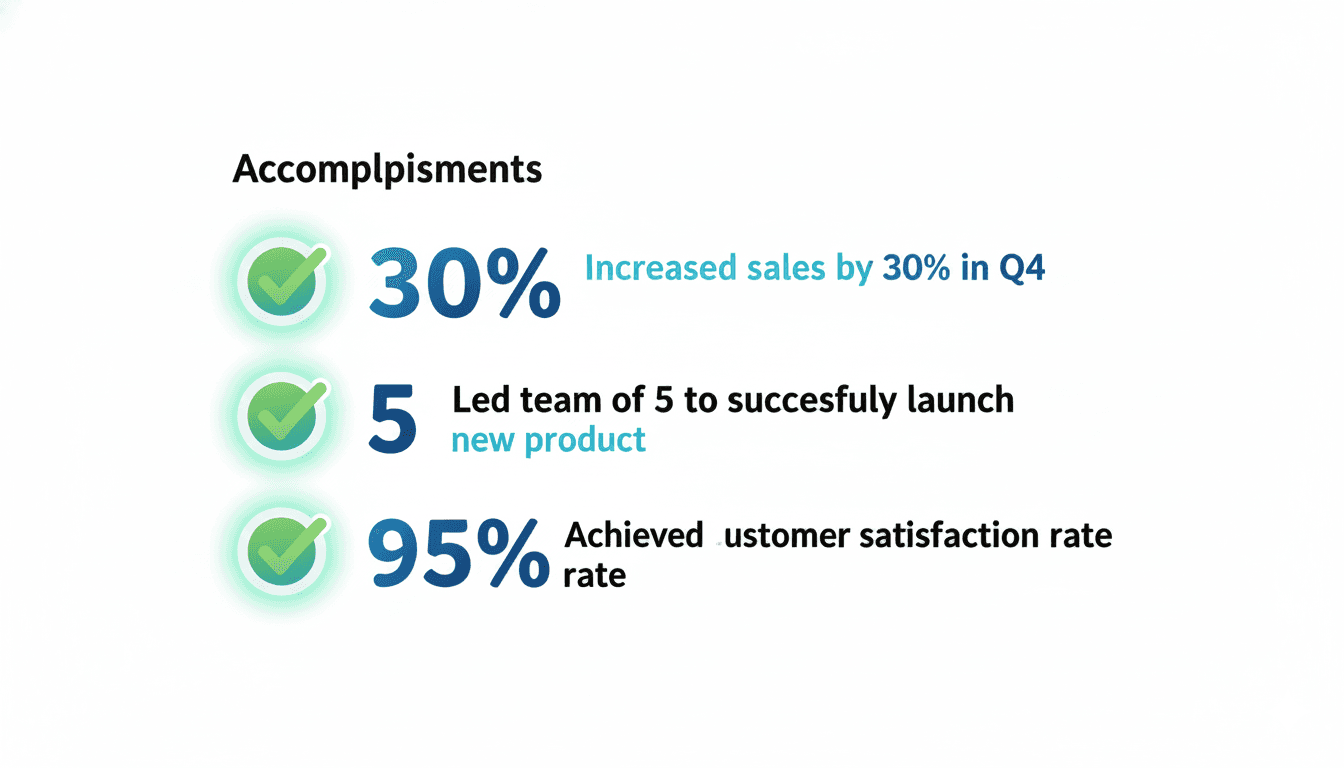
Recruiters do not hire responsibilities. They hire results. In 2026, the fastest way to prove results is with quantified bullet points. If your resume bullets are vague, you are invisible. If they are specific and measurable, you become memorable.
The problem is that most people do not know how to quantify their work. They assume they do not have numbers, or they do not know which metrics matter. This is where an AI resume builder becomes a practical advantage. It can help you translate your day-to-day work into measurable impact, but the insight still has to come from you.
This guide shows you how to find metrics, apply the best bullet formulas, and use AI to craft high-impact resume bullets that stand out in 2026.
Why Metrics Matter More Than Ever
Hiring teams are overwhelmed with applicants. Metrics act as a shortcut to credibility. A bullet with a clear result is easier to trust, easier to remember, and easier to compare against other candidates.
A few examples:
- "Increased customer retention by 12 percent."
- "Reduced monthly reporting time by 30 hours."
- "Managed a $2.5M budget across three departments."
These numbers do not just show what you did. They show the scale and value of what you did.
The Three-Part Bullet Formula
A simple formula helps you build strong bullets quickly:
- Action: the verb that signals ownership.
- Scope: the size, scale, or context.
- Result: the measurable outcome.
Example:
"Redesigned onboarding workflow for 120 new hires, cutting time-to-productivity by 25 percent."
AI can propose this structure. Your role is to supply the truth and the context.
How to Find Metrics When You Think You Have None
Most roles have measurable outcomes, even if they are not obvious. Use these techniques to uncover them:
- Time savings: hours saved per week or month.
- Cost reduction: budgets, vendor expenses, or operational efficiencies.
- Volume: number of customers, tickets, projects, or accounts.
- Quality: error rates, customer satisfaction, or compliance scores.
- Growth: revenue, pipeline, user adoption, or retention.
If you still cannot find metrics, use estimates. A credible range is better than a vague statement.
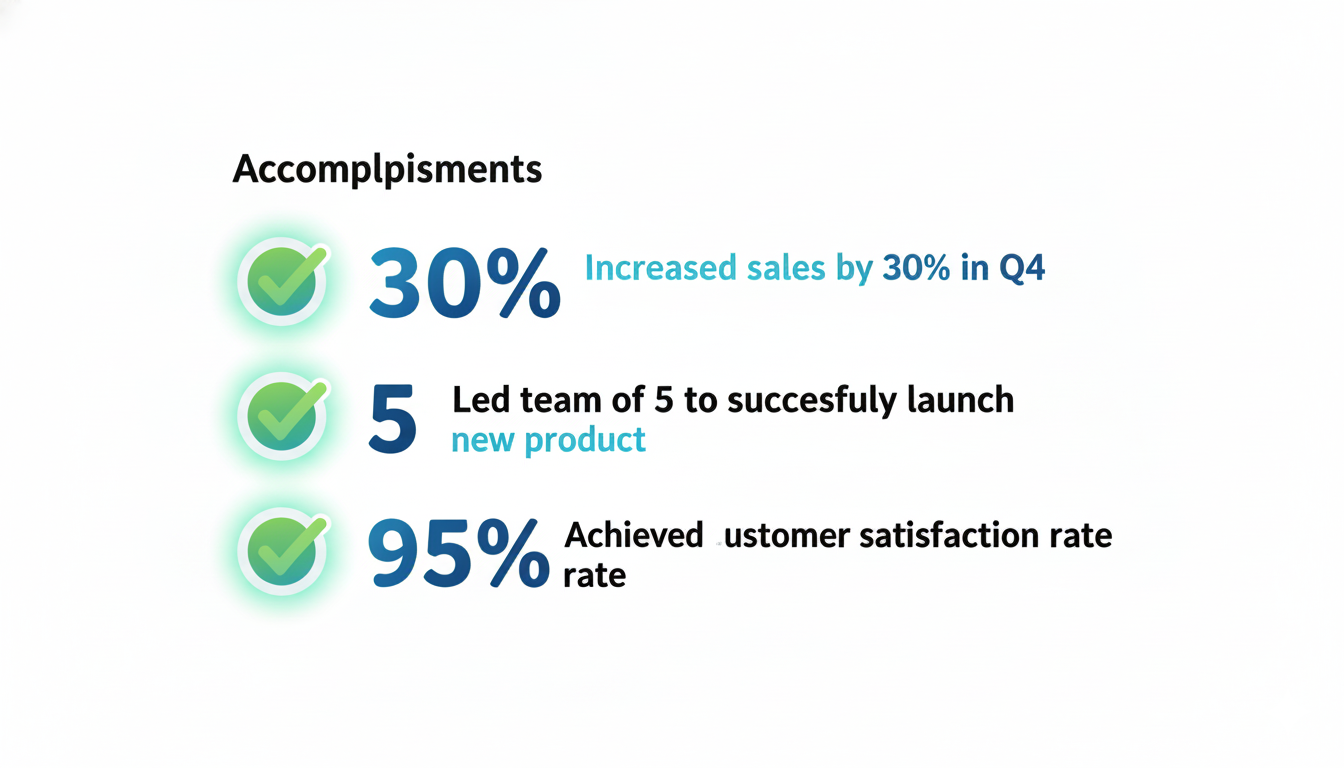
The XYZ Formula: The Classic That Still Works
The XYZ formula is timeless because it is clear:
"Accomplished X as measured by Y by doing Z."
Example:
- "Increased email conversion by 18 percent by redesigning segmentation and testing subject lines."
- "Reduced manufacturing defects by 22 percent by implementing a new QA checklist."
AI can turn raw inputs into polished bullets using this formula. It is one of the fastest ways to upgrade a resume.
The CAR Formula: Context, Action, Result
For roles that involve complex environments, the CAR format adds context:
- Context: the situation or challenge.
- Action: what you did.
- Result: the outcome.
Example:
"During a product launch crunch, coordinated cross-functional timelines and communications, enabling an on-time release that drove 15 percent revenue growth."
This approach works well for leadership roles, consulting, and project management.
Metrics That Matter by Role
Different roles have different impact signals. AI can suggest the right metrics when you feed it role context, but you should know the basics:
- Sales: revenue, pipeline, quota attainment, win rate.
- Marketing: conversions, CAC, ROI, traffic growth.
- Product: adoption, retention, churn, NPS.
- Operations: cycle time, cost reduction, compliance.
- Customer success: retention, expansion revenue, customer satisfaction.
Use metrics that hiring managers in your target role recognize.
Turning Daily Tasks Into Outcomes
A common mistake is listing tasks. AI can help you flip the perspective.
Task: "Prepared weekly reports." Outcome: "Automated weekly reporting in Excel and Power BI, reducing preparation time by 60 percent."
Task: "Answered customer calls." Outcome: "Resolved 40+ customer tickets per day with a 96 percent satisfaction score."
This transformation is the core of resume impact.
Use AI to Generate Multiple Variations
One of the best uses of AI is to create multiple versions of the same bullet. You can then select the one that feels most accurate and relevant to the job description. This is faster than rewriting manually and increases precision.
The workflow:
- Write the raw task.
- Provide the metric and scope.
- Ask the AI for three variations.
- Choose the version that best fits the target role tone.
This approach gives you control while maximizing speed.
Quantifying Leadership and Collaboration
Leadership metrics are not always financial. You can quantify:
- Team size.
- Cross-functional scope.
- Stakeholder groups.
- Projects delivered on time or under budget.
Example:
"Led a cross-functional team of 8 across engineering and marketing to launch a new onboarding flow, increasing activation by 20 percent."
This shows leadership, scale, and outcome in a single line.
Avoid Inflated or Unverifiable Numbers
AI can tempt you to exaggerate. Do not do it. Recruiters can sense inflated claims, and you will be asked to explain them in interviews. Use conservative, defensible numbers and be ready to describe how you achieved them.
Credibility builds trust. Trust gets offers.

The Metrics Mindset for Career Changers
If you are switching industries, metrics can be your bridge. Even if the domain changes, outcomes are universal. Efficiency, growth, cost savings, and customer satisfaction are valued everywhere.
Use AI to translate your outcomes into the new role language. This makes your experience feel transferable and relevant.
A Simple Metrics Discovery Worksheet
If you are unsure which numbers to use, build a worksheet for each role you have held. Answer these prompts:
- Volume: How many customers, projects, tickets, or accounts did you handle per week or month?
- Time: How long did key processes take before and after your improvements?
- Money: What budgets, revenue, or cost savings were involved?
- Quality: Did error rates, satisfaction scores, or compliance metrics improve?
- Speed: Did you reduce cycle time or turnaround time?
Even if you cannot find exact numbers, you can estimate. The worksheet helps you surface measurable outcomes that are often hidden in day-to-day work.
How to Estimate Metrics Without Guessing
Estimation is not guessing when it is grounded in reality. Use simple math:
- If you handled 5 clients per day, that is roughly 100 per month.
- If you saved 30 minutes per process and ran the process 4 times per week, that is 2 hours saved per week, or about 100 hours per year.
- If a new workflow reduced error rates from 10 percent to 7 percent, that is a 30 percent improvement.
Document your assumptions in a note for yourself. That way, you can explain the numbers in interviews if asked.
Before and After Bullet Transformations
Here are examples of how AI can help transform basic bullets into high-impact metrics:
Before: "Maintained client accounts." After: "Managed a portfolio of 75 client accounts, improving renewal rates from 82 percent to 92 percent."
Before: "Wrote reports for leadership." After: "Automated executive reporting in Power BI, cutting weekly reporting time by 6 hours and improving data accuracy by 15 percent."
Before: "Supported onboarding." After: "Redesigned onboarding for 120 new hires, reducing time-to-productivity by 25 percent."
These transformations use the same experience but highlight outcomes.
Metrics for Roles That Feel Non-Quantitative
Even creative or people-focused roles can be quantified:
- HR: time-to-hire, retention rates, candidate satisfaction.
- Design: conversion lift, usability scores, project turnaround time.
- Customer support: ticket resolution time, CSAT, first-contact resolution.
- Content: traffic growth, engagement rates, lead generation.
If you feel stuck, ask: "What improved because of my work?" The answer usually includes a measurable signal.
Align Your Metrics With Interview Stories
The resume is the preview. The interview is the proof. Make sure each metric bullet has a supporting story you can explain. If a bullet says "reduced cycle time by 30 percent," you should be able to describe what you changed and why it worked.
This alignment builds trust. It also makes interview preparation easier because your resume already outlines your strongest stories.
How AI Resume Builders Make Metrics Easier
CareerLyft and similar tools can:
- Suggest metrics based on role context.
- Offer action verbs that signal impact.
- Identify gaps where metrics are missing.
- Create a consistent, ATS-friendly structure.
The key is to provide accurate input. AI can help you say it better, but it cannot invent the truth.
A Quick Metrics Checklist
Before you finalize, check:
- At least 60 percent of bullets include a number.
- Each role has one bullet showing a major outcome.
- Metrics are clear and comparable.
- The metrics align with the target role.
If you can check these boxes, your resume will stand out.
Frequently Asked Questions
What if my company does not track metrics?
Use estimates based on time saved, volume handled, or process improvements. You can also use ranges, such as "10 to 15 percent."
Are percentages better than raw numbers?
Both are useful. Percentages show improvement, while raw numbers show scale. If possible, combine them: "Increased conversion by 12 percent, adding 1,200 monthly signups."
How many quantified bullets should I have per role?
Aim for at least half of your bullets. Senior roles should have even more, as impact is the primary measure of value.
Can AI generate metrics for me?
AI can suggest plausible metrics, but you must validate them. Never include a number you cannot defend.
How does CareerLyft help with bullet points?
CareerLyft offers AI-generated bullet suggestions, action verb libraries, and ATS-safe formatting. The one-time payment model starting at $1.99 makes it easy to iterate without subscription pressure.
Final Takeaway: Metrics Are the Language of Results
In 2026, the best resumes are not the most creative. They are the most specific. Metrics turn your experience into proof. AI helps you write those metrics faster and with better structure, but the credibility still comes from you.
Use the formulas, find the numbers, and let your resume show the impact you already deliver.