

Artificial Intelligence has revolutionized the job search. In 2026, tools like CareerLyft have made it possible to create professional, ATS-optimized resumes in a fraction of the time it used to take. But as the saying goes, "with great power comes great responsibility."
While AI is an incredible drafting partner, it is not a replacement for human judgment. Many job seekers are falling into predictable traps—relying too heavily on the software and losing the "human touch" that ultimately gets you hired.
In this guide, we will explore the 10 most common pitfalls of using AI resume builders and provide actionable strategies to avoid them. By following these rules, you can ensure that your AI-assisted resume is not just technically perfect, but personally compelling.
Pitfall 1: The "Hallucination" Trap
AI models are trained to be helpful, and sometimes they can be too helpful. If you give an AI a vague prompt, it might "fill in the blanks" with information that sounds plausible but isn't actually true.
- The Mistake: Accepting an AI-generated bullet point that includes a tool you've never used or a result you didn't achieve.
- The Fix: Rigorously fact-check every line. If the AI suggests you "Increased sales by 25% using Salesforce," but you actually used HubSpot and increased sales by 10%, you must edit it. An AI-generated lie is still a lie, and it will be caught during the interview.
Pitfall 2: Losing Your Unique Voice
AI tends to write in a very specific "corporate-professional" tone. While this is great for passing the initial screen, it can make your resume feel robotic and indistinguishable from hundreds of other candidates.
- The Mistake: Using the AI's first draft without adding any of your own personality or specific anecdotes.
- The Fix: Use the AI for the structure and the keyword optimization, but inject your own "voice" into the summary and the project descriptions. Use a turn of phrase that feels natural to you.

Pitfall 3: Over-Optimization (Keyword Stuffing)
In 2026, ATS platforms are designed to detect resumes that are trying to "game the system." If your resume is just a list of keywords with no narrative flow, it will be flagged.
- The Mistake: Including every single keyword from a job description, even if it doesn't fit naturally into your experience.
- The Fix: Focus on Semantic Alignment rather than exact matching. Use the keywords in the context of your achievements. If a keyword doesn't fit, don't force it.
Pitfall 4: Ignoring Formatting for the Human Eye
Some AI builders focus so much on the "data" that they forget that a human eventually has to read the document.
- The Mistake: Creating a resume that is a solid wall of text or has inconsistent spacing.
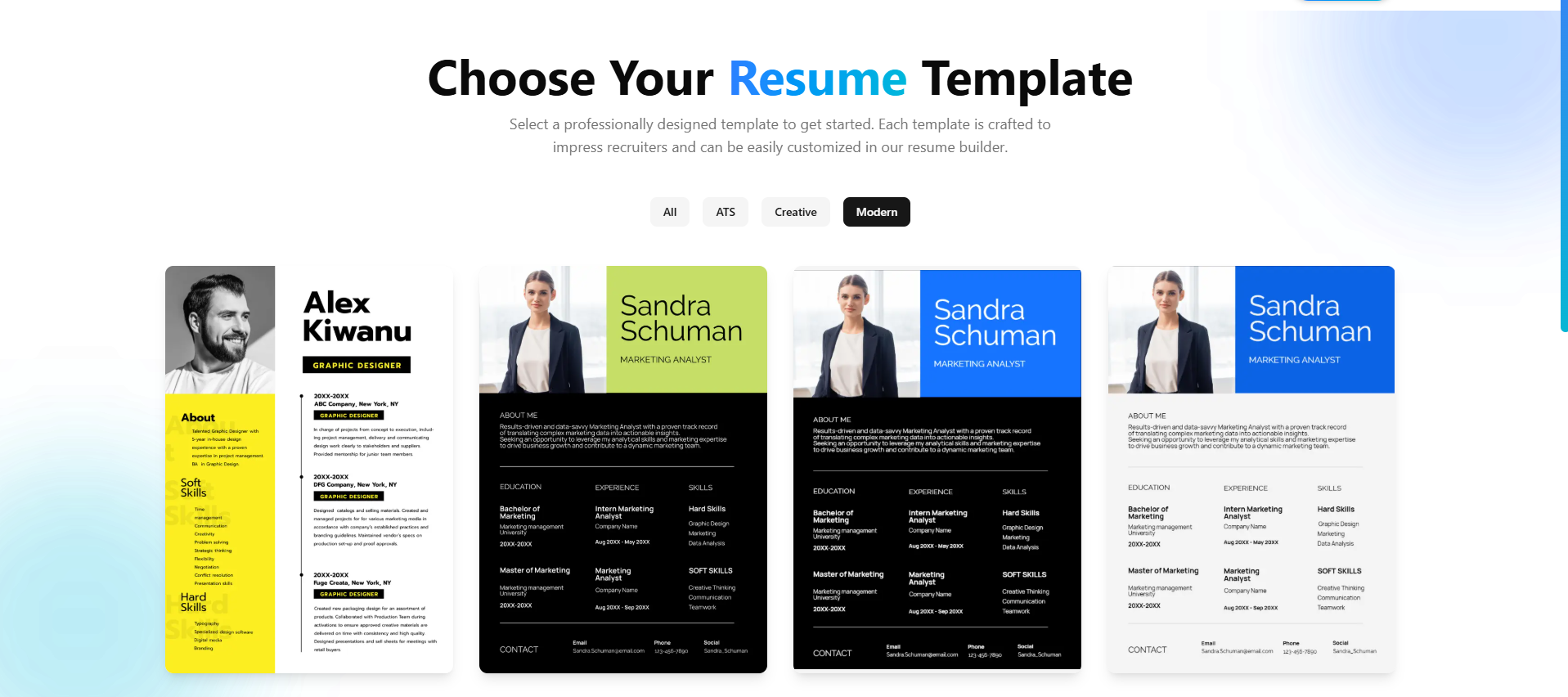
- The Fix: Choose a template that prioritizes white space and readability. Use bold text for your job titles and key metrics. At CareerLyft, our templates are designed to pass the "6-Second Human Scan."
Pitfall 5: The "Generic" Summary
Many AI builders generate a summary that says: "Motivated professional with 10 years of experience looking for a challenging role." This tells the recruiter nothing.
- The Mistake: Using a generic AI-generated summary that could apply to any candidate.
- The Fix: Use the "Bridge" formula. Your summary should state: Who you are + Your biggest achievement + The specific value you will bring to this company.
Pitfall 6: Neglecting the "Recent-First" Rule
AI sometimes struggles with the hierarchy of your experience. It might give as much space to a part-time job you had in 2015 as it does to your current leadership role.
- The Mistake: Having a resume where the most relevant information is buried on the second page or at the bottom of a list.
- The Fix: Ensure your resume follows a Reverse Chronological format. Your current or most recent role should have the most detail and the most impressive metrics.
Pitfall 7: Forgetting to Tailor the "Skills" Section
It's tempting to create one "perfect" skills list and use it for every application. But in 2026, recruiters are looking for specific "Technical Clusters."
- The Mistake: Listing "Microsoft Office" on a resume for a Senior Data Scientist role.
- The Fix: Curate your skills list for every job. Remove skills that are irrelevant to the target role to make room for the ones that actually matter.
Pitfall 8: Using Outdated Action Verbs
AI models are trained on historical data, which means they sometimes suggest verbs that have become clichés (e.g., "Led," "Managed," "Assisted").
- The Mistake: Using passive or overused verbs that don't convey impact.
- The Fix: Replace generic verbs with High-Impact Power Verbs. Instead of "Managed the team," use "Orchestrated the workflow" or "Mobilized the department."
Pitfall 9: Inconsistent Branding Across Platforms
In 2026, your resume is just one part of your digital footprint. If your AI-optimized resume is perfect but your LinkedIn profile is a mess, it creates a "Trust Gap."
- The Mistake: Having different job titles, dates, or summaries on your resume vs. your LinkedIn.
- The Fix: Use your AI builder to sync your branding. CareerLyft can generate content for your LinkedIn "About" and "Experience" sections that perfectly match your resume.
Pitfall 10: Not Proofreading (The "AI Blindness")
After looking at an AI-generated document for an hour, your brain starts to fill in the gaps. You might miss a subtle error or a placeholder (like "[Company Name]").
- The Mistake: Sending a resume that contains AI placeholders or subtle grammatical inconsistencies.
- The Fix: Print your resume out and read it backward. This forces your brain to look at each word individually. Alternatively, use a separate tool (like a basic spell-checker) for a final sanity check.
Conclusion: Use AI as a Co-Pilot, Not an Auto-Pilot
AI resume builders are the most powerful tools available to the modern job seeker. They can help you overcome writer's block, optimize for the ATS, and save hundreds of dollars. But they are only effective when used with intention.
Think of AI as your Co-Pilot. It handles the navigation and the heavy lifting, but you are the Pilot. You are responsible for the truth, the tone, and the final destination.
By avoiding these 10 pitfalls, you can create a resume that combines the technical precision of AI with the authentic story of your career.
Ready to build a pitfall-free resume? Start with CareerLyft.ai today.
The "Safety Check" Checklist
- [ ] Did I fact-check every metric the AI suggested?
- [ ] Did I remove any skills that aren't relevant to this specific job?
- [ ] Does my summary include the name of the company I'm applying to?
- [ ] Did I check for AI placeholders like "[Insert Result Here]"?
- [ ] Does the tone of the resume sound like me when I read it out loud?
Frequently Asked Questions
Is it okay if my resume looks like other AI-generated resumes?
The layout (template) is fine—recruiters actually prefer standard, easy-to-read layouts. What matters is the content. As long as your bullet points are specific to your real achievements, your resume won't look "generic."
Can ATS detect "AI Writing"?
Some experimental tools claim to detect AI writing, but their accuracy is very low. More importantly, recruiters don't care if you used AI, as long as the information is true and you can perform the job. Using AI to help you write is seen as a sign of digital literacy in 2026.
How does CareerLyft prevent hallucinations?
Our AI is designed to be "Grounding-First." Instead of just generating text from scratch, it asks you for the "Facts" first, and then uses its AI engine to polish and optimize that specific data.
Should I use the AI to write my cover letter too?
Yes, but follow the same rules! Use the AI to generate a structure and a first draft, then add a specific personal story that the AI couldn't possibly know.